
Design for Disassembly to Ensure Future Reuse of Building Materials
- Jan 22
- 6 min read
Design for disassembly” (DfD also called Design for Deconstruction) is intended to ensure the future reuse of building materials, preferably as directly as possible. Since it is difficult to predict, especially about the future, it is also challenging to foresee whether the materials we build with today can and will be reused in the future. While there is general agreement on the principles that should ensure DfD in a construction project, mechanical joints, clean materials, etc., there are currently different methods to measure the degree of DfD in a project. Within the PROBONO project, our partner, COWI has taken a closer look at the principles behind a couple of the most prevalent measurement methods and made suggestions that can provide a deeper understanding.
"One must be able to measure in order to improve" and "You get what you measure." Two truths that should be the focus both when choosing a measurement method and when interpreting the results.
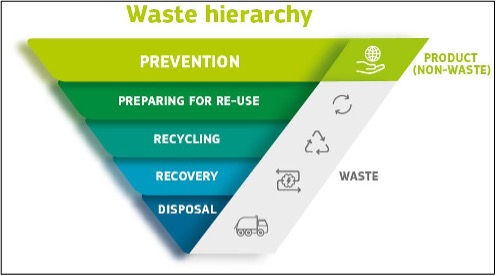
When measuring DfD, it is natural to focus on the potential degree of reuse in the future, so the first criterion is to be able to classify the "degree" of reuse. Here, there is general consent on basing it on the European Waste Directive, which operates with 4 classes of waste and a fifth called prevention (Figure 1), meaning avoiding waste. Of the 4 waste classes, it is of course about avoiding the last one, disposal, where nothing is recycled, and in general to reach as high as possible, preferably reuse where as much as possible – up to 100% – is kept within the circular cycle.
Measurement methods will typically assign each level in the hierarchy with a coefficient or “score” which the higher it is, the higher the class is in the hierarchy. Often the 4 basic classes are also subdivided into more.
Common methods for measuring sustainability in the EU are Level(s) and DGNB:
· Level(s) is developed as a common EU framework of core indicators for the sustainability of office and residential buildings, providing a set of indicators and common metrics for measuring the performance of buildings along their life cycle. More specifically, for DfD Level(s) provides the 2.4 indicator ‘Design for Deconstruction, reuse and recycling’.
· DGNB is a voluntary certification system that assesses buildings based on their environmental, economic, and social quality as well as technical and process-related solutions. Originally from Germany (Deutsche Gesellschaft für Nachhaltiges Bauen), it is now an important standard in several European countries. Currently, DGNB operates with two methods for measuring DfD, namely the method in the 2023 edition and the 2025 edition. The principle is basically the same, namely the classification of materials into categories according to the waste hierarchy. An overview of classes and scores for the different methods can be seen in Table 1.
As can be seen from (Table 1), there is a difference in the number of levels (from 4 in DGNB 2023 to 10 in DGNB 2025) as well as a difference in the scores assigned to each level. However, there is general agreement to place reuse in the upper 75-100%, recycling at 30-75%, recovery at 10-30% and disposal at 0 to 5%.

It is however striking that none of the methods include level A, preservation. The analysis is carried out on the assumption that the (entire) building will be demolished, using a 50-year consideration period, corresponding to the consideration period for LCA. At COWI, we believe that poses a risk of underestimating the sustainability potential of a number of materials. The highest class of recycling is to preserve, so that no waste is created. This places several demands on the material, which may be contrast with requirements for recycling at a high level. For example, in-situ concrete is often very suitable for terrain- and load-bearing structures but will score low in future reuse upon demolition. The same applies to masonry built with cement mortars. If, on the other hand, you look at the material's potential for preservation beyond a 50-year consideration period, it has great durability and a long lifespan, enabling the entire structure to be preserved. COWI proposes to include level A, preservation, for materials that have a potential in the building beyond 50 years. These materials should also be assessed for their final potential in demolition. This means that for the entire building, you can calculate a percentage of materials that have a potential beyond 50 years, and at the same time for all materials have the final score at demolition. This gives a more nuanced picture of the building's future circularity potential.
The amount of material is calculated in Level(s) and DGNB in either mass, volume or monetary value. If a material has a service life of less than 50 years, it is included with the number of times necessary to cover 50 years of service life (as in LCA). The total score is then calculated by multiplying the amount of material in the desired unit by the DfD score, and then dividing by the total amount, to get a dimensionless score 0-100 for DfD, which can then be compared to other buildings. Here, too, it makes good sense to calculate the proportion of the building with level A, in order to be able to compare (benchmark) different designs. COWI proposes to also or alternatively make the calculation in GWP[2], i.e. embodied CO₂ for the analysed materials. It will often turn out that the heavy materials (concrete, bricks, metal, etc.) also have the highest amount of embodied CO₂, but when calculated in kg CO₂ eq, the method becomes more accurate in relation to GWP.
A final very important part of the DfD analysis is the method of placing the materials at the different levels. All mentioned methods are based on principles from ISO 20887:2020 Sustainability in buildings and civil engineering works - Design for disassembly and adaptability - Principles, requirements and guidance, where several criteria for promoting DfD are listed, such as the previously mentioned: mechanical, reversible joints, clean materials, etc. Level(s) use these criteria, but also include the market conditions for the materials, and ask questions about whether there is a market for recycling the material. In DGNB 2023, a QL (quality level) class is predefined for most common materials. If a class is to be deviated from, this must be documented by the assessor. In DGNB 2025, there are also predefined scenarios for recycling in the specified classes, but at the same time you must specify collection methods, purity, etc. to achieve the final score.
Of course, the placement of each material at the correct level is central to the final score. The requirement for reversible joints can be difficult to comply with for some materials, even though the technology exists. For example, if you use prefabricated concrete hollow core slabs, or HCS for short, you will usually have to carry out cast joints to ensure rigidity in the structure and to achieve sufficient fire safety. In both Level(s) and DGNB 2023/2025, this will place HCS low down in the hierarchy. COWI would like to challenge this assessment. A recent Danish project (P)RECAST[3] (2022-2025) has just shown through practical experiments that HCS elements can quite easily be removed in their entirety from buildings from the 1970s in Denmark, by simply cutting the joints. While it is unproblematic to harvest the elements, the major obstacle to reuse is that you have no knowledge of the concrete quality, reinforcement, etc. of the elements. Therefore, they are often crushed. For this reason, our partner, COWI, believes that, when it comes to prefab concrete elements, in many cases it is more important to focus on retaining all relevant information rather than using mechanical joints. We know that calculation methods and norms are likely to continue to change, but if you have all the information about the calculation bases and material qualities used, you will be able to recalculate in the future without having to take samples.
Based on our work in the PROBONO project, we would therefore like to point out some important elements in a DfD analysis:
Use a standardised methodology to assess the potential for future reuse. It is important to use methods that make DfD measurable and make it possible to compare across different designs and construction projects.
Gain a deeper understanding of the potential by adding a few elements:
Assess the total amount of material in % (by mass, GWP or monetary is secondary) that have the potential to be preserved in the building at a lifespan over 50 years. In other words, get an overview of the materials that can potentially be preserved in the building during a renovation after 50 years. This must be considered the very highest level of recycling and shows the building’s potential for a lifespan beyond 50 years.
Consider calculating the score based on the GWP of the materials, to better understand the GWP-saving potential of reuse.
Challenge the assessment of certain materials – it is not always assembly methods that are crucial for future use – but it is always important to retain all technical information about materials and structures for future use.
[1] The point score in DGNB 2023 differs according to material
[2] GWP: Global Warming Potential
[3] (P)RECAST – Reuse of Precast Concrete Elements, partially funded by the Environmental Technology Development and Demonstration Program (MUDP) under the Danish Ministry of Environment.


Comments