
HVAC4PEOPLE: Towards Zero-Energy Buildings
Numerical tools developed by ITA within PROBONO project to improve thermal comfort and energy performance of buildings were presented at IC2: Innovation Industry Construction Congress celebrated 1-5 June.
The current shift toward green building development requires the accurate design of HVAC systems and building envelope solutions, with digitalization serving as a key enabling technology in this transition.
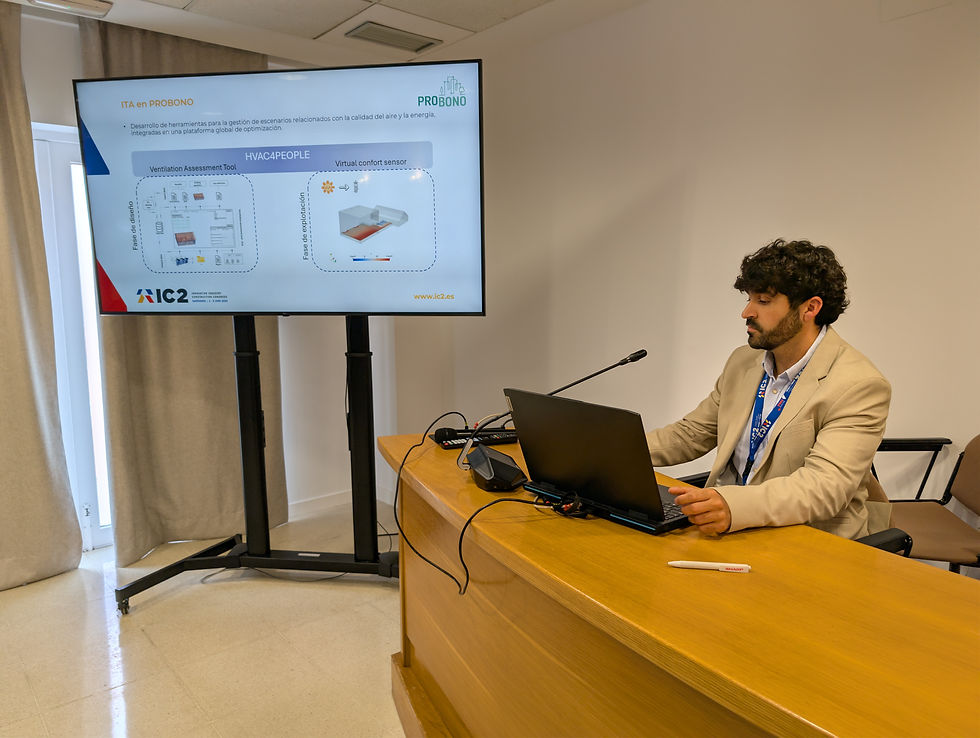
HVAC4People is a set of tools based on open-source solutions which aim to improve building performance in terms of energy efficiency and occupants’ thermal comfort at different stages of the building life cycle.

Ventilation Assessment Tool (VAT)
Supports the early-stage design of new and retrofitted buildings. It relies on the automated generation of Computational Fluid Dynamics (CFD) models, making advanced CFD analysis accessible to non-expert users. The tool enables the evaluation of indoor environmental quality (IEQ), thermal comfort, and energy performance based on high-level inputs (construction materials, solar radiation loads, heating and cooling systems) and standardised IFC geometries from BIM models.
Accessible through the human machine interface (HMI) of PROBONO, supports informed and reliable design decisions.

Virtual Comfort Sensor (VCS)
Digital twins of the thermo-fluid dynamics of air inside the buildings to optimise its internal comfort. This kind of digital twins can be used as virtual sensors standing for an advanced support to energy management.
They are built applying reduced order models techniques on CFD data, through a methodology that connects to the VAT for the generation of training data from a DOE exploration.
Classical approach for building operation relies on the installation of physical sensors to control HVAC, which provides localised information that most of the times does not correctly capture the actual variable conditions within the building.
VCS provides detailed real-time distributed information and derived calculations which extends the available information that can be used for information and building operation optimization. It will be deployed at AIAS building in Aarhus University campus.


Comments